How to choose best AI engine for your business (hint - you don't)
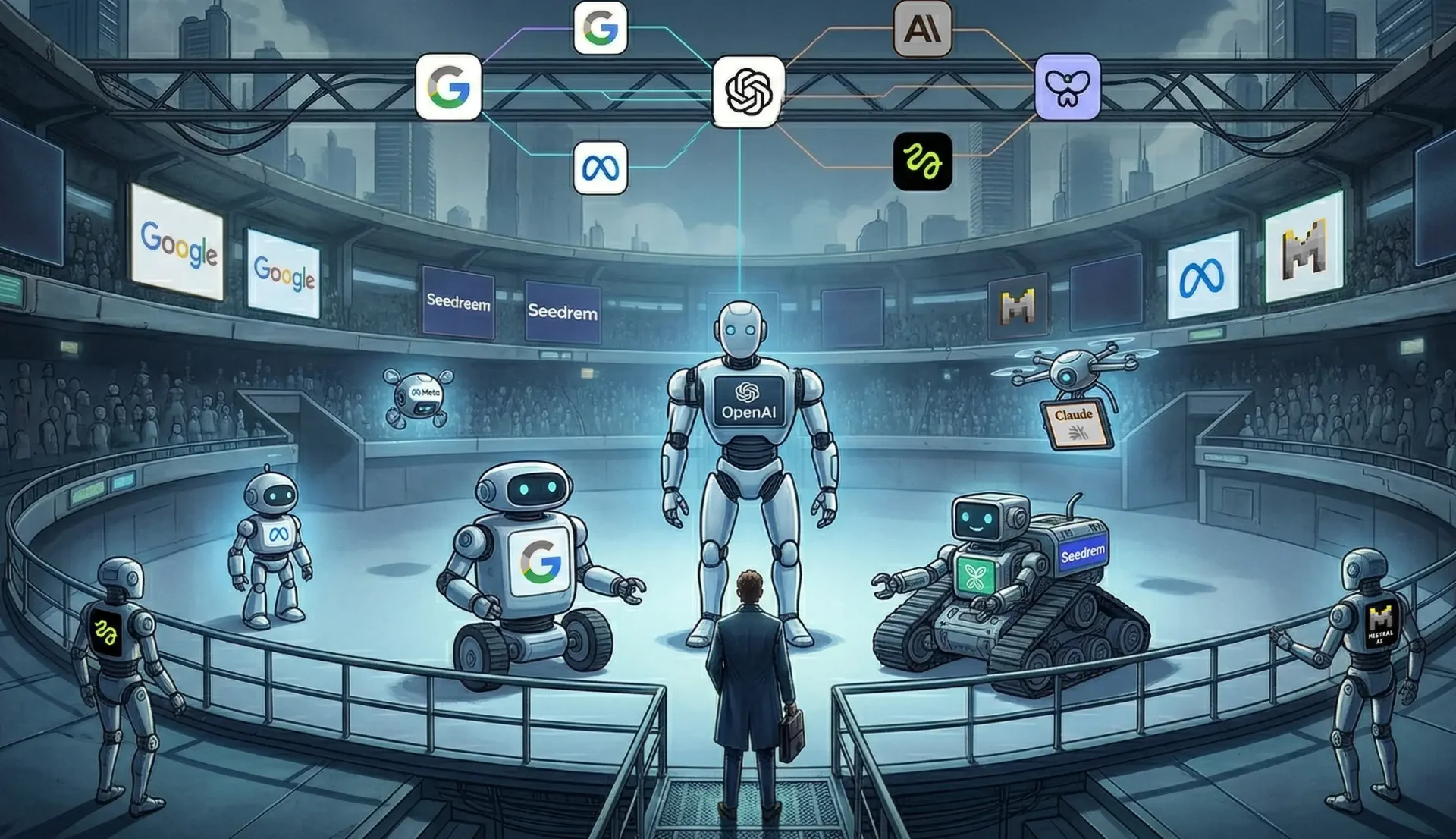
The generative AI boom is no longer a future trend; it's a core component of modern retail. With industry analysts reporting that the number of specialized generative AI models doubles nearly every 18 months, the landscape is exploding with possibilities.
But the most innovative companies aren't just using AI—they're architecting intelligent systems with it. The real competitive edge isn't found in adopting a single, all-powerful tool. It lies in building dynamic, multi-engine workflows that are more flexible, powerful, and future-proof than any monolithic solution.
This is the critical shift from using AI to orchestrating it.
The Trap of the 'One-AI-Fits-All' Mindset
In the rush to innovate, it's tempting to bet on a single, prominent generative AI provider. The logic seems sound: pick the perceived leader, integrate their API, and you're set. However, this strategy is proving to be a significant bottleneck for retail and eCommerce leaders who demand specialized, high-quality results at scale. Committing your entire visual commerce strategy to a single engine creates several critical risks:
Vendor Lock-In: You become dependent on one provider’s roadmap, pricing structure, and inevitable limitations.
Innovation Lag: As new, more specialized models emerge, your rigid system prevents you from adopting the best-in-class tool for each specific task.
Sub-Optimal Quality: A generalist model rarely outperforms a specialist. Using one AI for everything from background removal to shadow generation to scene composition inevitably leads to compromises in quality, requiring more manual intervention and diminishing ROI.
For tasks as nuanced as product visualization, where the goal is to increase buyer confidence, these compromises are not an option. A single generic AI simply cannot master the complexities required to close the confidence gap effectively.
The Blueprint for a Dynamic AI System
So, how do you harness the full power of generative AI without falling into the single-provider trap? The answer lies in building a dynamic, modular system that acts as an intelligent orchestrator. This system doesn't rely on one tool; it leverages a portfolio of best-in-class AI models, assigning each one to the specific task it excels at.
Here’s a high-level look at the difference:
This 'best-of-breed' approach begins with deconstructing your workflow. For enhancing a product catalog, this means breaking it down into micro-tasks like isolating the product, generating a lifestyle scene, placing the product, rendering realistic lighting, and writing a description. Each task is then routed to the optimal AI engine via its API, ensuring every component of the final output is of the highest possible quality.
But how do you choose the 'best' engine? That requires a continuous and structured evaluation process.
Key Criteria for Evaluating and Benchmarking AI Models
A dynamic system isn't 'set it and forget it'; its strength is its ability to evolve. Implementing a continuous benchmarking process is crucial. When evaluating AI models for your workflow, measure them against these four core pillars:
1. Output Quality & Consistency
This is the most critical metric. Does the model produce results that meet your brand's aesthetic standards? Is the output consistent across thousands of iterations? For visual generation, this includes realism, adherence to prompts, and the absence of artifacts.
2. Speed & Latency
How quickly does the model return a result? For customer-facing applications, low latency is essential. For large-scale backend processing, throughput might be more important. Measure the API response time under various loads to ensure it meets your operational needs.
3. Cost-Effectiveness
Evaluate the cost per API call or per generated unit. The most expensive model is not always the best. A slightly lower-quality but dramatically cheaper model might be the right choice for a less critical task in your workflow, optimizing your overall spend.
4. Scalability & Reliability
Can the provider's API handle your peak volume without performance degradation? Check their uptime history and Service Level Agreements (SLAs). An unreliable API can bring your entire production pipeline to a halt.By continuously scoring models against these criteria, your modular system allows you to swap in a superior performer with minimal disruption, ensuring your visual commerce strategy not only keeps pace with innovation but leads it.
Our Learning: Dynamic Workflows in Action
This philosophy is the bedrock of the Viziq platform. Early on, we learned that no single AI model could deliver the versatile, high-fidelity results our customers required—especially when it came to maintaining brand-specific aesthetics and rendering realistic material physics. This challenge drove us to build our platform not as a tool, but as a sophisticated orchestration engine.
When a client uploads a single image, our system deconstructs the request and routes parts of the process to a variety of specialized AI engines: one for precise object detection, another for generating rich, contextual environments, and yet another for perfecting the physics of light and shadow. This dynamic, multi-engine workflow is what enables us to consistently generate visuals that increase buyer confidence and help reduce returns.
The Future is Flexible: Why Dynamic AI is Your Only Path Forward
Adopting a multi-engine approach is a business imperative. This leads to a critical decision: build or buy? Building an in-house orchestration layer is a significant engineering undertaking, requiring a dedicated team to constantly scout, test, and integrate new AI models. Alternatively, partnering with a platform that has already mastered this dynamic approach allows you to leverage best-in-class AI without the R&D overhead.
The benefits are clear and directly impact the bottom line:
Future-Proofing: Your operations are shielded from the volatility of the AI market.
Unmatched Quality: You consistently produce superior results by leveraging specialized tools.
Enhanced Efficiency: Smart automation accelerates your time-to-market.
Sustainable ROI: You build an intelligent asset that grows more powerful over time.
As the AI landscape continues to fragment into powerful specialists, the most critical skill won't be model selection, but system architecture. The question you must ask is: is your organization building a dependency or a dynamic asset? By moving away from monolithic solutions, you can build a truly resilient and powerful engine for growth.
Ready to move beyond single-tool solutions and build a truly resilient visual commerce strategy? It's time to embrace the power of dynamic AI to close the confidence gap and accelerate your brand's growth.